⬅ Dashboard

📝 Text Classification Report

VNTC (Vietnamese News Corpus) Analysis & Modeling

📚 01. Dataset Overview

Collected from multiple major online newspapers in Vietnam (VnExpress, Tuổi Trẻ, Thanh Niên). To maintain balance, we limited the dataset to a subset.

🔗 Source
~7,000
Subset Articles
10
News Topics
700
Max Samples / Class
128
Max Sequence Length

🔍 02. Exploratory Data Analysis (EDA)

Class Distribution
Imbalanced Data: The original dataset shows a significant imbalance (as seen in the chart). Chính trị Xã hội and Thể thao dominate, while Đời sống and Khoa học are minorities.
Balanced Subset Solution: Due to this large imbalance, we explicitly limited the number of samples per class to a maximum of 700 samples to ensure fair representation during training.
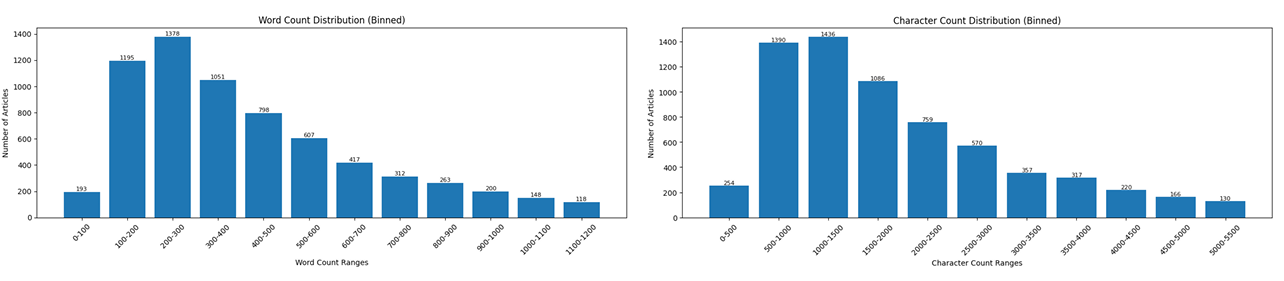
Word Distribution
Length & Style Distribution

The distribution of word and character counts is right-skewed (long tail). The Đời sống (Lifestyle) class is the longest on average (588 words), while Vi tính (IT) is the shortest (372 words).

📄 VNTC Dataset Sample
Label: Chính trị Xã hội

"Quảng Đông sẽ giết khoảng 10.000 cầy hương vì SARS. Trung Quốc vừa đưa ra thông báo trên, ngay sau khi các nhà khoa học thuộc Đại học tổng hợp Hong Kong phát hiện có điểm tương đồng về gene giữa virus..."

⚙️ 03. Setup & Preprocessing Pipeline

  • Word Segmentation: All texts are preprocessed using VnCoreNLP to correctly group Vietnamese compound words (e.g., converting "học sinh" to "học_sinh").
  • Subword Tokenization: Apply Byte Pair Encoding (BPE) to tokenize text into subwords, generating integer sequences optimized for the model architectures.
  • Padding/Truncation: Input sequences are truncated or padded to a strict maximum length of 128 tokens.
# Import necessary libraries
from transformers import AutoTokenizer
from pyvi import ViTokenizer

# 1. Word Segmentation (Grouping compound words)
raw_text = "Tàu du lịch cao tốc Cần Thơ"
segmented_text = ViTokenizer.tokenize(raw_text)
# Output: 'Tàu du_lịch cao_tốc Cần_Thơ'

# 2. Load Pretrained PhoBERT Tokenizer
tokenizer = AutoTokenizer.from_pretrained("vinai/phobert-base")

# 3. Subword Tokenization, Padding & Truncation
encoded_input = tokenizer(
    segmented_text,
    padding='max_length',
    truncation=True,
    max_length=128,
    return_tensors='pt'
)

🏗️ 04. Model Building Pipeline

💡 Approach: We contrast two powerful paradigms for NLP: Recurrent Neural Networks (LSTM) trained from scratch vs. Pre-trained Transformer models (PhoBERT) fine-tuned for classification.

RNN: LSTM (Trained from scratch)

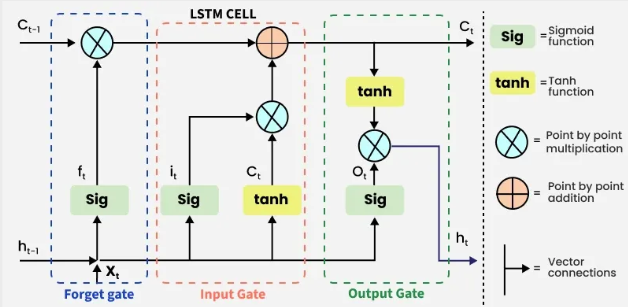
LSTM Architecture

Contains an Embedding layer (dim=300), an LSTM layer (hidden=256), Dropout (0.3), and a FC layer. Trained with Adam (LR=1e-3) for 5 Epochs with Batch Size 16.

Transformer: PhoBERT (Fine-tuned)

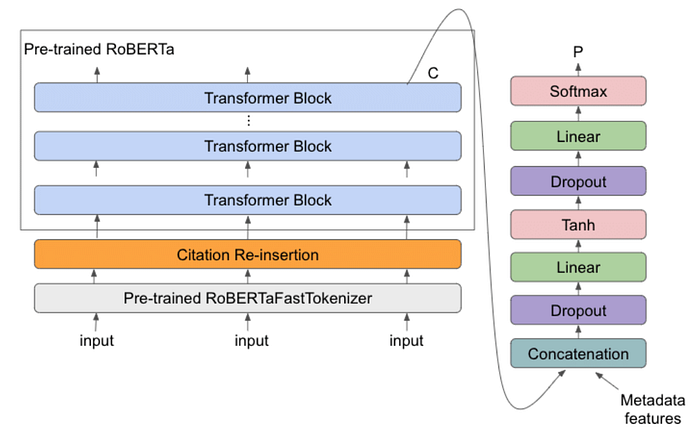
PhoBERT Architecture

Based on RoBERTa architecture. To improve efficiency and prevent overfitting, we froze the transformer encoder and only trained the classification head. Trained with AdamW (LR=1e-3) for just 2 Epochs with Batch Size 8.

🔥 Core Logic: Freezing PhoBERT's Encoder
train_phobert.py
# Load the pre-trained PhoBERT model
model = AutoModelForSequenceClassification.from_pretrained("vinai/phobert-base", num_labels=10)

# Freeze all layers in the base RoBERTa encoder to save compute and prevent overfitting
for param in model.roberta.parameters():
    param.requires_grad = False

# Only the weights of the classification head (classifier layer) will be updated
for param in model.classifier.parameters():
    param.requires_grad = True

🔄 Data Pipeline & Tensor Shapes

Below is the specialized data pipeline detailing the Tensor dimensions (Batch Size is denoted as B) and the semantic meaning of the data at each step.

Raw Input Text Strings
Tokenization (B, 128)
LSTM Backbone Feat: (B, 256)
PhoBERT Backbone Feat: (B, 768)
Class Head Logits (B, 10)
🧠 Classification Head: A Custom Head is attached on top of the backbone. It typically consists of a Dropout Layer (to prevent overfitting) followed by a Fully Connected Layer. This maps the backbone's high-dimensional textual representation vector (256 dimensions for LSTM, or 768 dimensions for PhoBERT) down to the final topic logits: (Batch, 10).
v

🏆 05. Evaluation & Results

Note: Evaluated on the test split (approx. 20% of the active dataset).

Performance Comparison (Test Set)

Model Accuracy F1-Score Train Time (s) Inference Time (s)
LSTM 0.6429 0.6354 ⚡ 410 ⚡ 23.27
PhoBERT (Frozen Head) 🏆 0.8341 🏆 0.8274 5856 2956
⚖️ The Trade-off Analysis: PhoBERT significantly outperforms LSTM (improving accuracy by nearly 19%). This proves Transformers' superiority in capturing complex semantic relationships and global context in Vietnamese. However, it comes with a massive cost: PhoBERT is 8 times larger in size and its inference is over 100 times slower than the lightweight LSTM.

Confusion Matrices

* Click on any matrix to view in full screen.

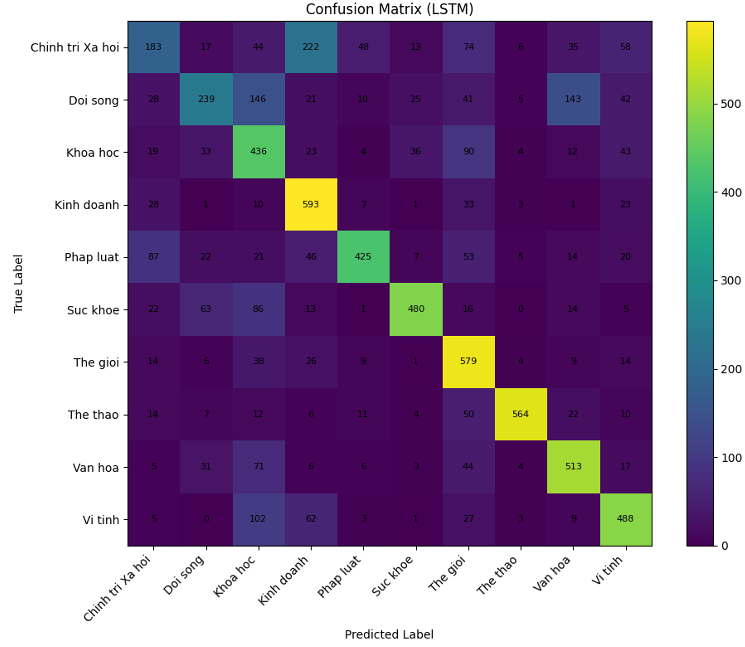
LSTM (Trained from scratch)

LSTM Confusion Matrix

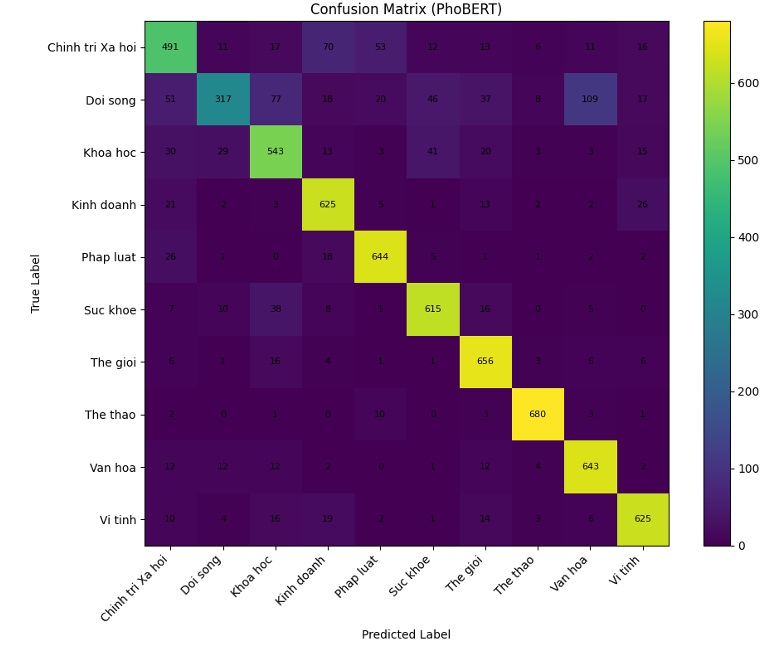
PhoBERT (Fine-tuned)

PhoBERT Confusion Matrix

🔬 06. Error Analysis

Common Confusions

By analyzing the Confusion Matrices above, we noticed both models struggle with multi-topic or ambiguous articles where semantic overlap exists. Here are the most frequent misclassifications:

  • LSTM: Chính trị Xã hội ➔ Kinh doanh (222 errors)
  • LSTM: Đời sống ➔ Khoa học / Văn hóa
  • PhoBERT: Đời sống ➔ Văn hóa (109 errors)
  • PhoBERT: Chính trị Xã hội ➔ Pháp luật

Real-world Error Examples

"Uỷ ban thuyết phục HĐND TP HCM cho tăng giá nước..."
TRUE: Chính trị Xã hội LSTM PRED: Kinh doanh
"Ngân hàng Chính sách xã hội thiếu vốn cho vay..."
TRUE: Chính trị Xã hội PhoBERT PRED: Kinh doanh
"Trại hè tiếng Anh Apollo sẽ diễn ra tại khu du lịch..."
TRUE: Chính trị Xã hội LSTM PRED: Văn hóa
📌 Insight on Errors: Articles discussing "prices" (giá nước) or "loans" (vốn cho vay) heavily skew the models towards the Kinh doanh (Business) class, despite the core subject being government policy. This highlights the challenge of classifying text based on overlapping vocabulary rather than deep contextual intent.
×